

Did Two Partial Water Changes And Cleaned Filter And Nitrates Are Still High
You lot might not be able to see them, but nitrates are hiding in every aquarium.
Understanding this invisible compound is an important part of maintaining happy and healthy fish.
Today, I'm going to teach you everything you would want to know about them.
Earlier I continue, I want to make certain you lot read The Nitrogen Cycle guide.
This cycle forms the foundations of what I am about to tell you.
Got it under wraps?
Expert.
And so, let'due south continue….
at a glance: OUR Acme PICKS FOR MAINTAINING NITRATE LEVELS
What are nitrates and where practise they come from?
Nitrates (NO3) are a class of dissolved nitrogen that occur naturally in the water cavalcade , which is the water inside your aquarium.
Exactly how nitrates get into your aquarium is quite a journey… Nitrates are actually a by-product of biological waste matter.
Common sources of excess waste found in aquariums include:
- Uneaten fish nutrient
- Fish poop
- Decaying plants
- Muddy filters
FishLab Fact: Overfeeding is the number one cause of high nitrate levels in aquariums. Not but do overfed fish poop more, simply any uneaten food rots, leading to even more nitrates. Overstocking your aquarium comes in equally a close second – watch that bioload!
Just while waste results in nitrates, it is not the cause of nitrates.
To explicate, I am going to practice a very brief recap of the nitrogen cycle.
Before waste becomes nitrates, at that place are a couple of steps that happen first.
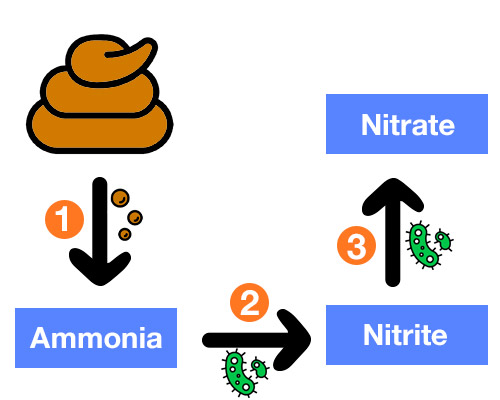
1. Every bit waste matter breaks down, information technology gives off ammonia.
2. A leaner called nitrosomonas breaks down the ammonia into nitrites.
3. A second bacteria, called nitrobacter then feeds on the nitrites and produces nitrates.
And then without nitrites, nitrates in your aquarium wouldn't exist.
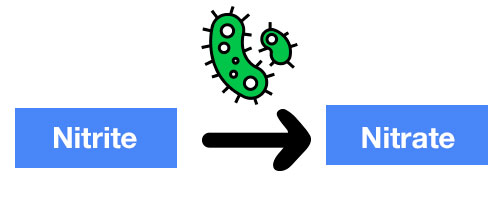
I know there is only a single letter separating the 2 – nitrIte versus nitrAte…
Only don't get confused. The two are very unlike.
Nitrites are highly toxic to your fish, while nitrates are considered harmless, at least in small amounts.
Now, I must stress this… harmless in small amounts.
Over time, nitrates will build upward in your aquarium. This process is continuous and unavoidable.
When this happens, you lot demand to reduce the nitrate levels in your tank, which I tell you how to do later in this guide.
What happens if your nitrate levels are too loftier?
FishLab Fact: A sudden leap in nitrate levels is called a nitrate spike.
I'll be frank with you, unless you stock sensitive fish or corals, it'southward unlikely that an increase in nitrate levels is going to outright kill your fish.
But that doesn't mean that loftier nitrate levels are not dangerous in their own fashion.
Yous see, high levels of nitrates place your fish under incredible stress.
And when your fish are stressed, the following problems tin arise…
ane. Increased risk of disease
Have you ever gotten and so stressed that you lot became sick?
Well, that's similar to what happens to your fish. The stress caused from increased nitrate levels make your fish more susceptible to diseases.
ii. Poor growth
Fish that are exposed to high levels of nitrates may accept stunted growth, significant they may never accomplish their total size.
three. Poor color
Fish that are stressed by high levels of nitrates won't display their natural coloring the way they would under normal, healthy weather condition. You may even find that your fish's colour will fade.
4. Damaged reproductive organs
If yous are trying to breed fish, then you definitely want to keep nitrate levels low! High levels can damage reproductive organs, pregnant your fish will be unable to make babies!
5. Reduced life bridge
Fish that constantly live in water with high levels of nitrates exercise not live as long.
While some of these issues are reversible, others cause permanent impairment to your fish or fifty-fifty shorten their lifespan.
To put it only, if you desire to raise happy and healthy fish, you demand to get your tank's nitrate levels under control.
What are the right nitrate levels for your aquarium?
The ideal nitrate levels for your aquarium depend on ii factors:
- The type of tank (freshwater, saltwater, etc.), and
- The type of fish, plants or invertebrates y'all stock.
FishLab Fact: The measure out for nitrates is ppm (parts per million). For y'all metric folk, this is the aforementioned every bit mg/L (milligrams per liter).
In a perfect globe, nitrates should exist kept between 5-10 ppm or lower.
All the same, this is not ever the example…
Whether it's due to a lack of fourth dimension to perform proper maintenance, laziness or just a lack of agreement, fish often alive in extreme nitrate levels.
But just because your fish are surviving, that doesn't mean they are happy or healthy.
Beneath are suggested upper limits for nitrate levels that should non be exceed for freshwater and saltwater tanks.
Freshwater tank nitrate levels
| Freshwater tank | < 40 ppm |
| Planted tank | < 30 ppm |
| Brackish | > l ppm |
| Pond | > 50 ppm |
Saltwater tank nitrate levels
| Reef tank | < 1 ppm |
| FOWLR | < 30 ppm |
| Coral tank | 0.25 ppm |
Note: The nitrate levels above are general guidelines. Private species of fish, plants or invertebrates may have more specific requirements. And remember: Merely because your tank is inside those limits doesn't mean that your fish are happy.
As you can run across from the charts, marine fish are much less tolerant of high nitrate levels than freshwater fish.
FishLab Fact: High nitrate levels tin can pb to affliction, cause reproductive failure and may even stunt growth in fish.
If you go on a infirmary tank for any sick or injured fish, proceed the nitrate levels in this tank beneath x ppm.
It is also worth mentioning that many varieties of algae feed off nitrates in the h2o.
Many algaes use nitrates every bit a food source. In this case, I recommend keeping the nitrate levels below 10 ppm. This helps deprive the algae of its food source, making it easier to eradicate.
FishLab Fact: The "lower nitrates are better" rule is thrown out the window if you lot have a planted aquarium. Many plants utilize nitrates for food, and in this case, low nitrate levels can really cause issues and tin even lead to a blue-greenish algae (cyanobacteria) outbreak.
How do y'all test for nitrates?
To identify the nitrate levels in your aquarium, all you need to do is leave and purchase a colorimetric test kit that is specifically for nitrates.
Nitrate test kits are typically designed to piece of work for both saltwater and freshwater aquariums.
If you take ever tested pH , then you will know how these exam kits piece of work.
Take a sample of water from your aquarium, add a couple of drops of the solution included in the examination kit and watch the water change color.
Beneath are two of the all-time nitrate test kits around:
API Nitrate Test Kit
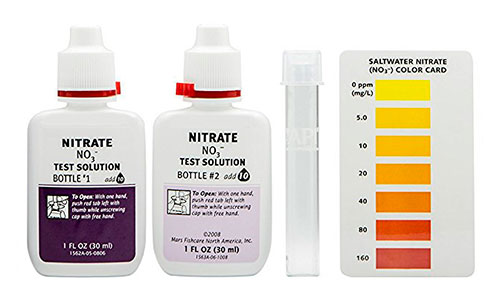
Lasts up to 90 tests If you walk into your local fish store, this will probable be the test kit they go along on the shelf.
What can I say? Information technology's cheap, and it works. For the everyday fish keeper, the API test kit will exist more than appropriate.
If you purchased the API Master Test Kit , then you lot will already have this examination kit, forth with many others.
Nonetheless, since nitrate test kits are technically measuring nitrites, they take the same shortcomings that the nitrite test kits accept – amine interference.
In certain cases, such as in reef tanks, essential amino acids – amines – can cause the tests to bear witness a lower nitrate level than what is actually occurring in your tank.
Fortunately, there are exam kits that get around this issue.
Unfortunately, many of these kits are expensive.
But not this i…
Salifert Nitrate NO3 Test Kit
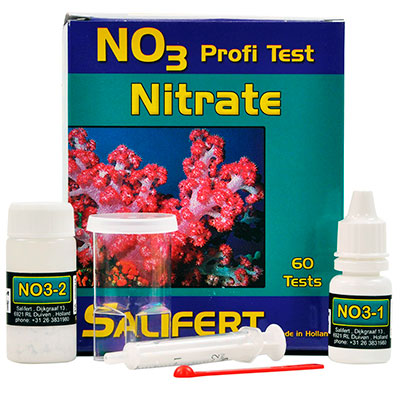
Lasts up to 60 tests
This nitrate examination kit hits the sweet spot for both price and performance.
It may not last every bit long equally the API test kit, but it makes upwardly for this past beingness easy to employ with accurate results.
The Salifert nitrate examination kit is popular with many saltwater aquariums owners.
Since it tin exist picked up for but a few more dollars than the API kit, I recommend making this your go-to nitrate exam kit.
While nitrate test kits are easy to use, their accuracy depends on your ability to follow the instructions.
I highly recommend reading the instruction manual thoroughly earlier using a examination kit. Skipping a simple step, such as shaking the bottle, tin can cause an incorrect reading.
How do you remove nitrates from your aquarium?
Simply tested your nitrate levels and discovered information technology's through the roof?
Don't panic!
I am now going to cover all the ways you can lower the nitrate levels in your aquarium.
Only before we jump into this section, I want to make one thing clear:
The battle against nitrates is never over!
Every bit long as your fish are eating and pooping, there is going to be waste in your aquarium, which ways that unless y'all act, your nitrate levels are going to continually rise.
The only manner to win this battle is to remove every fish, Aquatic found and natural organism from your tank – at which point, I would hardly phone call it an aquarium.
If that isn't an pick for you, and it shouldn't be, so you demand to monitor and reduce the nitrate levels on a regular ground.
So, the key takeaway is:
Yous cannot eliminate nitrates – you can only control them.
Now that we accept that out of the way, allow'due south take a closer look at the unlike means y'all can remove nitrates from your aquarium.
1. Water alter!
A partial water change should already be a part your maintenance routine.
And if it isn't? Well, it's no wonder your nitrate levels are and so loftier.
A h2o change is a nifty way to instantly lower the nitrate levels in your aquarium.
Y'all should also be mindful that nitrates can be present in tap water. This is a particular problem for those who draw water from wells.
If you use tap h2o for your water change, test for nitrates before putting it in your tank. If high levels of nitrates are found, consider using a different water source, like reverse osmosis (RO) h2o.
If your aquarium is under control, a regular water change should be all that is needed to adequately reduce nitrates to safe levels.
All the same, for those who need a bit more help in the fight against nitrates, at that place are iii more solutions to lower the nitrate levels in your aquarium.
Be mindful that these extra tips for removing nitrates won't replace a water change – they should be used in improver to it.
2. Water conditioner
This is essentially a nitrate remover in a canteen. Just add the recommended corporeality and lookout man your nitrate levels drop equally if by magic.
Exactly how the water conditioner reduces nitrates varies from brand to make. Some catechumen the nitrates to nitrogen gas, allowing information technology to exit through the surface.
Other h2o conditioners bind the nitrates, rendering them harmless to fish and making information technology possible for the leaner in your biological filter to destroy them.
Whatever the method, the end result is the same – lower nitrates.
I go far no hush-hush that my favorite water conditioner is Seachem Prime…
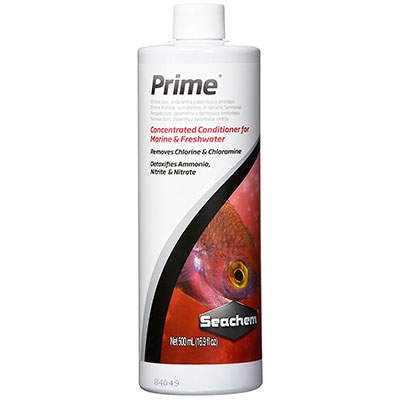
Non only can it detoxify nitrates, merely it tin also deal with nearly any other water quality issue that may arise!
I highly recommend keeping a canteen on hand merely in case of an emergency.
3. Nitrate removing filter media
While the bacteria in your filter might do a great job of getting rid of nitrites, nitrates are another story.
You can give your filter a turbo charge by using a media that traps nitrates, removing them from the h2o.
You can also use a bio-media, a media that uses leaner to filter the water, for nitrate removal…
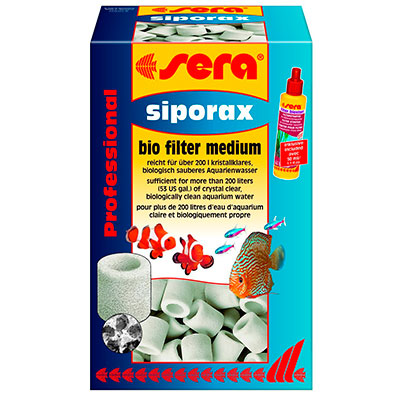
If you take been in the fish-keeping game for a long time, you might remember the name Siporax. If you are like me, yous probably thought that information technology had vanished forever.
But it turns out that Siporax is fantastic at encouraging the growth of denitrifying bacteria that breaks downwardly nitrates!
Realizing its potential, Siporax was reintroduced to the marketplace by Paul Hughes, who owns 1 of the most impressive display tanks in the entire United Kingdom. [eleven]
In that location are also nitrate reducing pads…
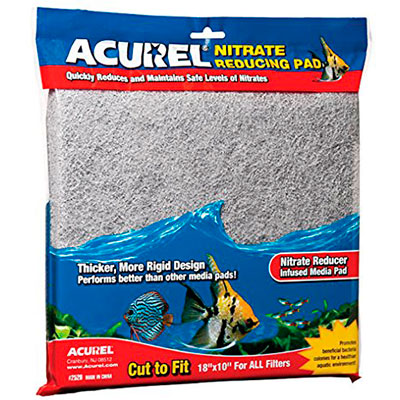
There are likewise nitrate reducing pads… These pads are infused with nitrate-reducing agents to trap and remove nitrates from your water.
The best role well-nigh these nitrate pads is that they tin exist cutting to size.
It doesn't thing whether you have a small HOB filter or large pond filter, you are guaranteed that the pad will fit.
However, nitrate pads practice accept an obvious drawback – they need to be replaced constantly. The typical lifespan for a nitrate pad is 2-3 months, afterwards which it needs to be tossed in the trash.
4. Become planting!
Plants naturally use nitrates.
This is why high nitrate levels frequently result in an algae outbreak.
However, it is important to note that plants draw nitrates out of the tank water at dissimilar rates.
In fact, most plants are rather ineffective at lowering nitrate levels.
Nevertheless, in that location is one planting solution that was designed specifically for nitrates… Rather than planting inside your aquarium, consider planting inside your filter.
Plants such as lucky bamboo and pathos not only await great when growing out the pinnacle of your aquarium, just their roots depict up nitrates equally they laissez passer through your filter, removing them from the arrangement.
Important!
While there is no arguing that the methods listed to a higher place work exceptionally well at reducing nitrate levels, in that location is one thing you need to be aware of:
These methods only remove nitrates – they don't set up the crusade of them.
If your nitrate levels are constantly spiking, then it won't matter how often you reduce the nitrate levels in your aquarium. The cause is still at that place.
Merely don't worry, I have a solution for yous…
How do you prevent nitrates from building upwards?
If you read my guides on ammonia and Nitrites, and so yous will already be fully aware of the advice I am going to give you.
That'southward because ammonia, nitrite and nitrate share a common cause.
Waste -> Ammonia -> Nitrite -> Nitrate.
It all starts with waste matter.
Past getting waste product nether control, y'all minimize whatever bug caused further down the nitrogen bicycle.
While these tips won't remove or reduce existing nitrates in your aquarium, they volition terminate new nitrates from building upwards as speedily – which is a good affair!
1. Don't overfeed your fish!
The more your fish eat, the more they are going to poop. And the more they poop, the faster nitrates will build up inside your aquarium.
I would as well add that any nutrient that remains uneaten sinks to the bottom of your aquarium and rots. And, you know what that means? More nitrates!
Remember, merely because you don't overfeed your fish doesn't hateful that someone else in your family isn't.
I learned this the difficult way… I kept finding uneaten pieces of food rotting in the corner of my tank. I feed my fish a premeasured amount, and they eat every last slice. But where this extra nutrient was coming from had me stumped.
Well, it turned out my nephew was sneaking in and feeding the fish when I wasn't looking. Mystery solved.
two. Maintain your plants
If you have live plants in your tank, then y'all want to incorporate a fleck of underwater gardening.
Over time, old leaves on your institute will dice.
When this happens, the leaves fall off and disuse, which leads to an increase in nitrate levels.
Become ahead of this by doing a bit of light pruning.
Every time you see expressionless or dying $.25 of plant affair, snip them off and remove them from your aquarium.
3. Clean your filter
You know all those loose bits of food, plant organic thing and poop? Well, they are sucked upwardly and trapped past your filter.
With time, this waste matter accumulates. When this happens, your filter turns into a nitrate manufacturing plant.
Regular maintenance will stop the built-up waste from reaching problem levels.
One popular solution is to use an intake sponge filter – literally a sponge that covers the intake to your filter.
The sponge traps any gunk that floats through the aquarium water, trapping it before it reaches your filter.
Merely remove the sponge to clean it – no more taking your filter apart!
4. Take hold of a gravel vac
substrate tin can apace get a graveyard of rotting fish food, expressionless plants and whatever else that gets defenseless upwardly in it.
All of these contribute to nitrates forming in the water.
A gravel vac is one of the most constructive ways to remove this from your substrate.
Easy to use, affordable and constructive – if your tank has a substrate, in that location is niggling excuse for non owning a gravel vac.
Ideally, y'all should exist performing a gravel vac during most, if not all, water changes.
5. Monitor your stock
An overstocked aquarium is going to have more nitrate problems than an understocked one.
It'due south unavoidable. Besides many fish in a small aquarium will create more waste product than the fish tank can handle, which is a surefire recipe for a spike in nitrate levels.
If your fish tank is overstocked, yous have two solutions:
- Get rid of some of your fish or
- Buy a larger aquarium.
I know it can be difficult to say bye to fish, just it'due south for their own good. They are just going to suffer in an overstocked tank.
Or, if you don't desire to say good day to your fishy friends only withal, buy a bigger tank.
You lot take been looking for a adept excuse to buy a larger aquarium, and nitrate issues are every bit skilful a reason every bit any to make the upgrade!
Don't be tempted to buy more fish now that yous accept a larger tank – that'southward what got you into this whole mess in the first place.
Conclusion
Phew! If you are yet with me, then you made information technology to the cease of this guide!
I know it's a lot to accept in, simply nitrates are an of import part of every aquarium, and understanding their role and how to control them is essential to raising happy and salubrious fish.
Exercise yous have any nitrate tips? Let me know in the comments beneath!

Source: https://fishlab.com/nitrate/
Posted by: williamsfiverand.blogspot.com
0 Response to "Did Two Partial Water Changes And Cleaned Filter And Nitrates Are Still High"
Post a Comment